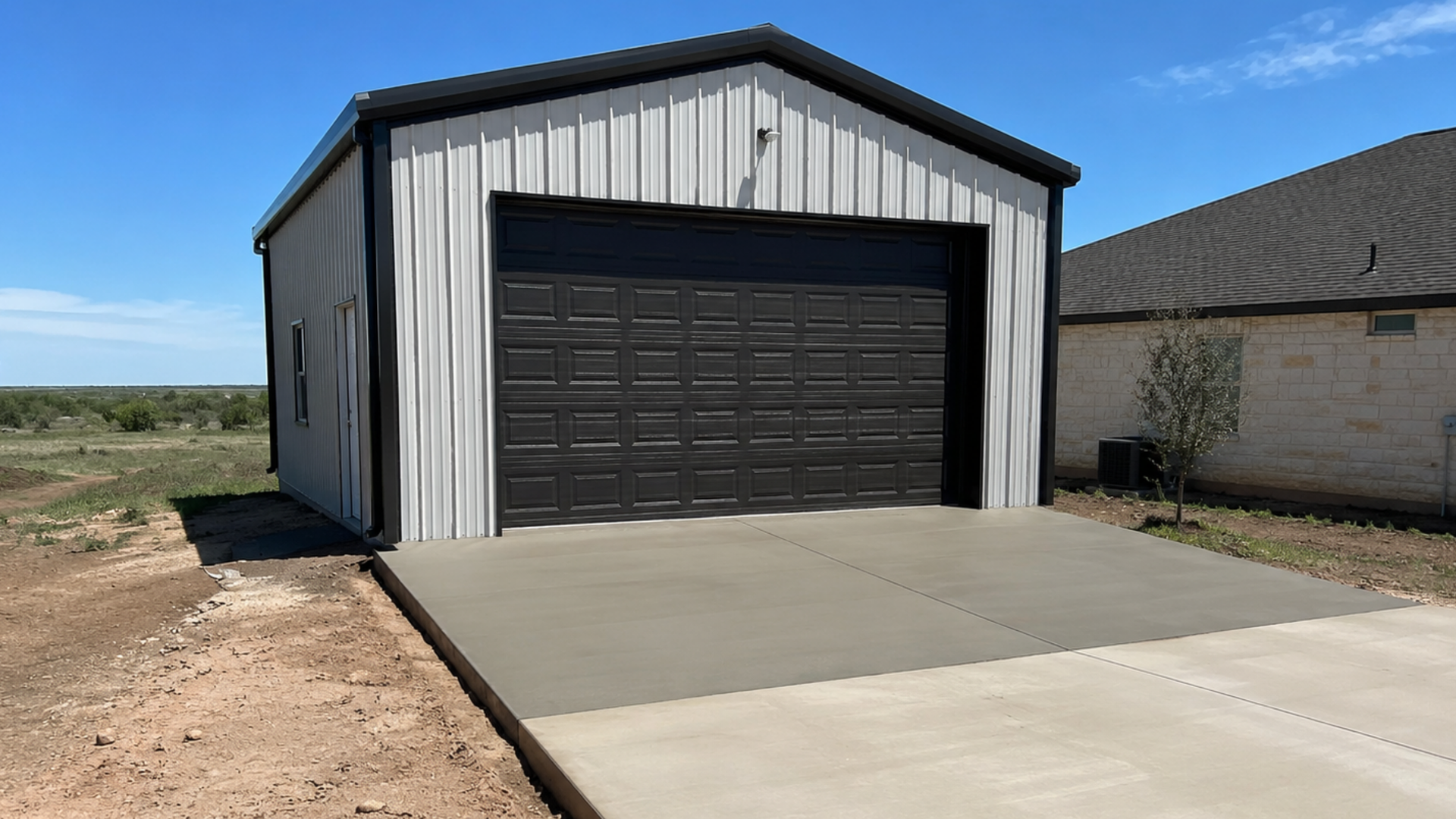
The Best Time of Year to Pour Concrete in Midland, TX
If you are trying to pin down the best time of year to pour concrete in Midland, TX, the short version from crews who work the Permian Basin year round is this: mid-March through May, and late September through November. Those two windows give you daytime highs in the 70s and low 80s, overnight lows that stay well clear of freezing, and enough moderation that a slab cures at a steady, predictable rate.
The calendar is only part of the story, though. Midland sits at roughly 2,800 feet in a hot semi-arid climate where the air runs dry, the wind rarely quits, and a 40-degree swing between afternoon and sunrise is an ordinary Tuesday. Those conditions work on fresh concrete harder than most property owners realize. A pour that would be uneventful in Houston can lose surface moisture here fast enough to cause trouble inside the first two hours.
This guide covers what actually changes month to month in West Texas, what a contractor adjusts to hold quality steady, and how to build a project timeline that lands your pour in a good window instead of a difficult one.
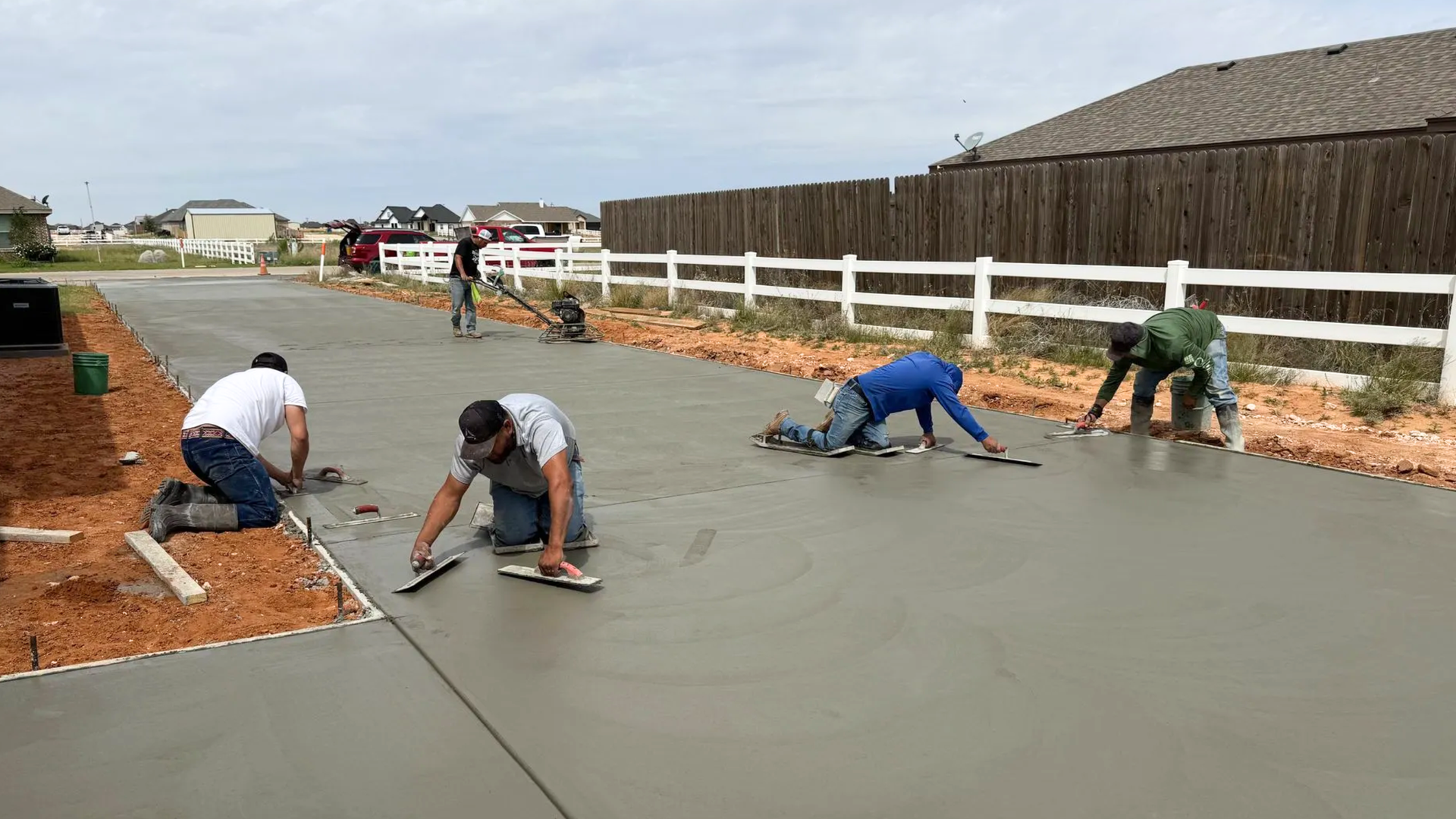
The Short Answer for Midland Property Owners
Fall is the single strongest season for concrete work in Midland. October in particular is close to ideal, with normal highs near 81 degrees and lows around 53. The heat has broken, the spring wind has settled, and there is usually enough runway before the first hard freeze for the slab to gain real strength.
Spring runs a close second. March and April bring comfortable temperatures, but April is also the windiest month of the year in Midland, and wind pulls moisture off a fresh surface just as aggressively as heat does.
Summer and winter are both workable. They simply require more from the contractor. Plenty of excellent concrete gets placed in Midland in July and in January. What separates a good July pour from a bad one is not luck. It is scheduling, mix design, and the crew's willingness to change how they work.
Why Timing Matters More in Midland Than in Most of Texas
Concrete does not simply dry. It cures, through a chemical reaction between cement and water called hydration. That reaction needs moisture and a reasonable temperature to proceed correctly. Anything that pulls water out of the slab too early, or slows the reaction to a crawl, shows up later as surface problems, weak spots, or cracking.
Three local conditions drive that risk in Midland.
Low Humidity and High Evaporation
Midland's relative humidity bottoms out around 38 percent in April and stays low through the summer. Dry air draws water out of a fresh slab surface continuously. When the evaporation rate climbs past roughly 0.2 pounds per square foot per hour, the American Concrete Institute flags it as the point where plastic shrinkage cracking becomes likely. Those are the fine, random cracks that appear on the surface within the first few hours, before the concrete has hardened.
The Midland version of this problem is that you can hit that threshold on a day that does not feel extreme. Add moderate wind and low humidity to an 88-degree afternoon and the math gets there quickly.
Wind Is the Factor Most Homeowners Overlook
Wind speed has a larger effect on evaporation than air temperature does. Midland averages close to 14 mph in April, with gusts considerably higher, and spring frontal passages regularly push well past that. A breezy 78-degree day in April can be harder on a fresh pour than a still 95-degree day in July.
This is why an experienced crew will occasionally push a pour by a day even when the forecast looks pleasant. They are reading the wind, not just the temperature.
Wide Day-to-Night Temperature Swings
Midland routinely runs a 30 to 40 degree spread between the daily high and the overnight low. In November, normal highs sit near 69 while lows drop to around 40. In March, it is 74 and 42. That spread matters because concrete placed on a warm afternoon can lose a lot of internal heat overnight, which slows strength gain right when the slab is most vulnerable.
Month-by-Month Concrete Pouring Conditions in Midland
The table below pairs Midland's 1991 to 2020 climate normals with what those numbers mean for a residential pour.
| Month | Avg High (F) | Avg Low (F) | Avg Rain (in) | Pour Rating | Main Consideration |
|---|---|---|---|---|---|
| January | 61 | 31 | 0.67 | Fair | Overnight freeze risk; protection required |
| February | 66 | 35 | 0.58 | Fair to Good | Late cold fronts, short cure window |
| March | 74 | 42 | 0.69 | Excellent | Wind picking up; watch gust forecast |
| April | 83 | 50 | 0.71 | Excellent | Windiest month; evaporation control |
| May | 90 | 60 | 2.0 | Good | Wettest month; heat starting to bite |
| June | 95 | 67 | 1.56 | Plan Carefully | Early starts and mix adjustments |
| July | 96 | 70 | 1.5 | Plan Carefully | Peak heat; warm nights slow cooling |
| August | 95 | 69 | 2.14 | Plan Carefully | Heat plus the year's heaviest rain |
| September | 89 | 62 | 1.99 | Good | Cooling off; storm delays possible |
| October | 81 | 53 | 1.52 | Excellent | Best overall balance of the year |
| November | 69 | 40 | 0.9 | Good | First hard freezes can arrive |
| December | 61 | 32 | 0.54 | Fair | Freeze protection required |
Two things stand out. First, Midland's wettest stretch is not spring in the way it is farther east. May, August, and September each average close to or above two inches, and that rain tends to arrive as brief, heavy storms rather than steady drizzle. A storm cell that dumps a half inch on a slab poured four hours earlier can damage the surface finish permanently.
Second, the shoulder months on either side of summer are genuinely good, not merely acceptable. September and May both work well if the crew watches the radar.
A Season-by-Season Look at Pouring Concrete in West Texas
Spring, March through May
Spring is a strong season with one asterisk on it. Temperatures land in the sweet spot, roughly 74 to 90 degrees for daily highs, and overnight lows climb steadily out of freeze territory.
The asterisk is wind. April is the windiest month in Midland and spring fronts bring sustained blows plus blowing dust. Crews compensate with windbreaks around the pour, evaporation retarders sprayed on the surface, and tighter timing between placement and the start of curing. If you are scheduling a large open slab such as a shop slab in April, expect your contractor to be watching hourly forecasts rather than the weekly outlook.
Spring is also the busiest booking season in Midland. Homeowners who wait until March to start calling contractors often find the calendar already full into June.
Summer, June through August
Summer highs sit in the mid 90s, with July normals hitting 96 degrees. Under those conditions, concrete sets faster, and faster is not better. A mix that would give a crew four hours of working time in October may give them half that in July, which compresses finishing and increases the chance of a rushed or uneven surface.
Summer pours in Midland get handled by shifting the schedule rather than avoiding the season. Trucks arrive at first light. Placement finishes before the worst afternoon heat. Aggregate and forms get wetted down beforehand so they are not pulling water out of the mix. On larger commercial or structural work, the concrete supplier may substitute chilled water or ice in the batch to bring the delivered temperature down.
The industry benchmark here is a maximum concrete temperature of 95 degrees at the point of discharge, per ACI 305.1. Anything above that requires supporting field experience or preconstruction testing before it is accepted. A reputable Midland contractor knows that number and works to it.
Summer also brings monsoon-pattern storms. August averages 2.14 inches of rain, and it usually falls in a handful of events. Build a rain contingency day into any July or August schedule.
Fall, September through November
This is the best stretch of the year for concrete in Midland. September cools into the upper 80s, October lands at 81 and 53, and November holds at 69 and 40. Wind moderates. The heat pressure is off. There is enough warmth left for good strength development without the race against evaporation.
The one thing to watch in late fall is the first hard freeze. Midland's normal December low is 32 degrees, and cold fronts can arrive earlier than the averages suggest. A pour placed in mid-November has plenty of margin. A pour placed the week of Thanksgiving may need overnight protection.
If you are planning a concrete patio or a driveway replacement, fall is the window worth targeting. Book it in summer.
Winter, December through February
Winter in Midland is milder than most of the country, and concrete work continues through it. Daytime highs near 61 degrees in December and January are perfectly workable. The issue is what happens after dark.
ACI 306R defines cold weather conditions as existing when air temperature has fallen to, or is expected to fall below, 40 degrees during the protection period. Midland's normal January low is 31 degrees. That means most January nights meet the definition, and protection is not optional.
Practically, that means insulating blankets over the slab, sometimes heated enclosures, and never placing concrete on frozen ground. Fresh concrete needs to reach roughly 500 psi before it can survive a freeze without damage, and in cold conditions that takes days rather than hours. Crews also stop using calcium chloride accelerators carelessly around reinforcing steel.
Winter is worth considering for one practical reason: contractor availability. Schedules loosen considerably between December and February, and a project that would wait six weeks in April may start in ten days in January.
What Changes on the Job Site From Season to Season
Hot-Weather Practices
In a Midland summer, a crew should be doing most or all of the following. Wetting the subgrade and forms ahead of the pour so they do not draw water from the mix. Scheduling early morning delivery. Using evaporation retarders and fog spray to keep the surface from drying ahead of the slab. Shading materials on site. Getting curing started immediately after finishing rather than at the end of the day.
The thing a crew should never do is add water to the truck to restore workability that heat has taken away. Extra water changes the water-to-cement ratio and permanently reduces strength. Slump loss is corrected with admixtures, not a hose.
Cold-Weather Practices
In winter, the priorities invert. Concrete arrives at a higher temperature. The ground is checked for frost before anything is placed. Insulating blankets go down as soon as finishing is complete and stay down through the protection period. Forms stay in place longer, because the slab is gaining strength more slowly.
Rapid temperature change is its own hazard. Pulling blankets off a warm slab into a 25-degree morning can cause thermal cracking, so protection comes off gradually.
Curing Is the Constant
Whatever the season, curing is where most residential concrete problems start. ACI 308R covers curing practice, and the underlying principle is simple enough: keep moisture in the slab long enough for hydration to run its course. Skipping or shortening curing is the single most common corner cut in residential concrete, and it is invisible on day one. It shows up two years later as dusting, scaling, or surface cracks.
Ask any contractor you are considering how they plan to cure your slab. A specific answer is a good sign.
Does the Best Time to Pour Change by Project Type?
Somewhat. Thickness, exposure, and structural role all shift the calculus.
| Project Type | Best Window | Why |
|---|---|---|
| Driveways | Oct-Nov, Mar-Apr | Large exposed surface; wind and heat sensitive. Needs full cure before vehicle loading. |
| Patios | Sep-Nov, Mar-May | Decorative finishes need working time that summer heat takes away. |
| Sidewalks and walkways | Year-round | Small pours, quick placement, easy to protect in any season. |
| Shop slabs | Oct-Nov, Mar-Apr | Big open pours are the most exposed to wind-driven evaporation. |
| Foundations | Sep-Nov | Structural strength gain benefits from moderate, stable temperatures. |
| Demolition and replacement | Year-round | Removal is season-neutral; time the new pour to the windows above. |
Smaller flatwork gives you the most flexibility. A short run of concrete sidewalks can be placed and protected in almost any month, because the pour is quick and the surface area is easy to cover.
Decorative work deserves a note. Stamped or broom-finished surfaces need a predictable window between placement and finishing. Summer heat shrinks that window and makes consistent results harder to achieve. If a decorative finish matters to you, fall is worth waiting for.
How Timing Affects Scheduling, Permits, and Cost
Permit Timing in Midland City Limits Versus Midland County
Where your property sits determines who issues your permit, and the two processes move at different speeds.
Inside Midland city limits, permitting runs through the City of Midland Development Services Department and the PermitMidland online portal. Most construction requires a permit obtained by the owner or a registered licensed contractor, and work cannot begin before issuance. Permits expire if construction does not start within 180 days.
Outside city limits, in unincorporated Midland County, driveway permits go through the Midland County Public Works office at 500 N Loraine Street. The timing detail that catches people out is the schedule: applications must be submitted by 3 p.m. on the Tuesday before a regular Commissioners Court meeting, and those meetings fall on the first and third Tuesdays of the month. Miss that cutoff and you wait roughly two weeks for the next window.
If your address is near the city boundary, confirm which jurisdiction governs before assuming. A Midland mailing address does not automatically mean city jurisdiction.
Booking Windows and Crew Availability
Demand in Midland follows the weather. Calls spike in March when the weather turns pleasant and again in September when the heat breaks. Both spikes hit right as the best pouring windows open.
The practical takeaway: contact contractors one to two seasons ahead of when you want the work done. If you want an October driveway, start conversations in June or July.
Where Cost Actually Shifts
Seasonal price differences in residential concrete are usually modest, but they are real. Winter work may carry added cost for blankets, enclosures, or heated water on larger jobs. Summer work may involve admixtures or chilled batch water. Neither is dramatic on a typical residential slab.
The larger cost variable is scope, not season. Site conditions, thickness, reinforcement, demolition of existing concrete, and drainage work move the number far more than the month on the calendar.
Building a Realistic Project Timeline
Working backward from your target pour date keeps the project from stalling.
| Time Before Pour | What Should Be Happening |
|---|---|
| 8 to 12 weeks | Contact contractors, schedule site visits, get estimates, confirm jurisdiction for permitting. |
| 6 to 8 weeks | Select contractor, finalize scope and layout, sign agreement, reserve a slot on the schedule. |
| 3 to 6 weeks | Permit application submitted. County applicants should target a Commissioners Court cutoff. |
| 1 to 2 weeks | Utility locates marked, site access cleared, demolition scheduled if replacing existing concrete. |
| Pour week | Weather monitored daily; excavation, grading, base prep, forming, and reinforcement completed. |
| Pour day plus 7 days | Curing protection maintained. Keep off the slab per your contractor's guidance. |
| 28 days | Concrete reaches its specified design strength. |
Foot traffic is generally fine within a day or two, and vehicle traffic typically waits about a week, though both depend on temperature, mix, and slab thickness. Your contractor should give you specific numbers for your project rather than a rule of thumb.
Timing Mistakes We See Most Often in Midland
Calling in March for a spring pour. By then the good spring slots are gone. The homeowners who get March and April dates called in December.
Judging a day by temperature alone. A mild, windy, dry afternoon in April can be harder on a slab than a hot, still morning in July. Wind and humidity belong in the decision.
Skipping protection on a borderline night. A forecast low of 38 degrees looks harmless. It is not, for concrete placed that afternoon.
Rushing to use a new slab. Concrete gains most of its strength in the first week and reaches design strength around 28 days. Parking a loaded work truck on a five-day-old driveway is a good way to create cracks that were entirely avoidable.
Assuming replacement can wait indefinitely. Deteriorating concrete tends to get worse through freeze-thaw cycling and drainage problems. If a slab is already failing, timing the demolition and concrete replacement for the next good window beats waiting another full year.
Frequently Asked Questions
What is the best month to pour concrete in Midland, TX?
October is the strongest single month. Normal highs near 81 degrees and lows around 53 give a slab moderate temperatures, reduced wind compared to spring, and enough warmth for steady strength gain before winter arrives. March, April, and November are close behind.
Can concrete be poured in Midland during the summer?
Yes. Summer pours are routine in West Texas and produce excellent results when handled correctly. Crews shift to early morning starts, pre-wet the subgrade and forms, use evaporation retarders, and begin curing immediately. ACI 305.1 caps concrete temperature at 95 degrees at discharge for general construction, and a qualified contractor works within that limit.
Is it safe to pour concrete in Midland during winter?
Yes, with proper protection. ACI 306R treats conditions as cold weather when air temperature falls to or below 40 degrees during the protection period, and Midland's normal January low of 31 degrees means most winter nights qualify. Concrete must not be placed on frozen ground, and the slab needs insulating blankets or enclosures until it develops enough strength to withstand freezing.
How long does concrete take to cure in Midland's climate?
Concrete typically reaches its specified design strength at 28 days, though it is usually ready for foot traffic within 24 to 48 hours and light vehicle traffic after about a week. Cold weather slows this timeline considerably, while summer heat accelerates the early set without necessarily improving final strength.
Does wind really affect a concrete pour in West Texas?
It does, more than most property owners expect. Wind speed drives surface evaporation harder than air temperature does. Midland averages close to 14 mph in April, its windiest month, and combined with humidity near 38 percent, those conditions can push evaporation past the threshold where plastic shrinkage cracking becomes likely.
How far in advance should I schedule a concrete project in Midland?
Plan on eight to twelve weeks from first contact to pour day for a typical residential project. That allows time for estimates, contract, permitting, and site preparation. If you are targeting a peak window such as October or April, start earlier, because those dates fill first.
Plan Your Pour With Precision Pours Concrete
The best time of year to pour concrete in Midland comes down to two windows: mid-March through May, and late September through November, with October the strongest month on the calendar. Summer and winter pours are entirely workable when the crew adjusts for heat or protects against freezing, but the shoulder seasons give you the widest margin.
Timing is one piece of a good outcome. Proper site preparation, correct reinforcement, thoughtful drainage, and disciplined curing matter just as much, and they matter in every season.
Precision Pours Concrete serves homeowners and businesses across Midland, Odessa, Andrews, Big Spring, Monahans, Stanton, Gardendale, and Greenwood, handling concrete driveway installation, patios, sidewalks, shop slabs, and foundation work throughout the region. Our team can walk your property, evaluate site conditions and drainage, confirm which permitting jurisdiction applies, and recommend a pour window that fits both your schedule and West Texas conditions.
Ready to get started? Request a free estimate or call (432) 400-4468 to talk through your project. You can also review our full service areas across West Texas to confirm we cover your location.